Inspector Bark Raises Questions About Accountability, Transparency, and the Culture Surrounding Animal Rescue
Featuring commentary originally published by Darcy Butkus, Inspector Bark
Animal rescue is supposed to be about one thing: the animals.
But what happens when the organization, activist, investigator, or individual doing the rescuing becomes the center of the story?
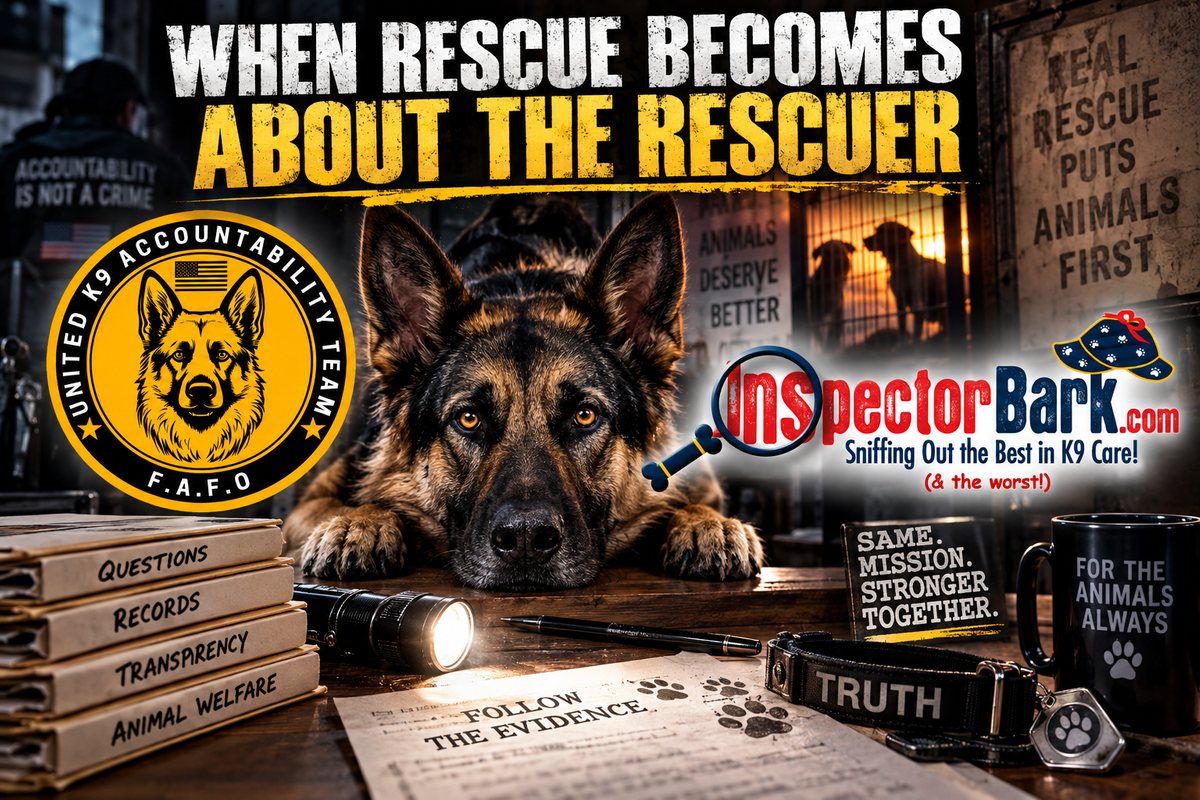
That is the question raised in a recent commentary published by Darcy Butkus of Inspector Bark, a licensed private investigator whose work examines conduct within the animal-care and rescue community.
Her message addresses a subject that deserves serious discussion: the difference between legitimate animal advocacy and what she describes as “rogue rescue.”
When the Mission Becomes the Image
Inspector Bark argues that rescue can sometimes shift away from helping animals and toward attention, control, praise, money, and maintaining a particular public image.
Among the warning signs she identifies are organizations or individuals who seemingly must always be portrayed as the hero, while anyone questioning their actions is immediately treated as an enemy.
That distinction matters.
Accountability is not inherently anti-rescue. Asking where donated money went is not anti-animal. Asking what happened to seized or surrendered animals is not an attack. Asking for veterinary records, documentation, outcomes, or explanations should not automatically make someone the enemy of animal welfare.
As Inspector Bark wrote:
“Legitimate rescue should be able to withstand legitimate scrutiny.”
That may be the most important point in the entire discussion.
What Happens When Questions Become “Attacks”?
Inspector Bark also raises concerns about how critics, former volunteers, fosters, adopters, veterinarians, and others can sometimes be characterized as jealous, unstable, disgruntled, or simply “out to destroy the rescue” after raising questions.
That creates a dangerous environment for accountability.
A legitimate organization should be able to respond to factual criticism with facts. If an allegation is wrong, documentation can demonstrate why. If a mistake occurred, acknowledging and correcting it can strengthen public confidence.
But when every question is treated as a personal attack, the conversation stops being about animal welfare and starts becoming about protecting reputations.
Donations Require Transparency
Animal rescue organizations frequently depend on emotional appeals to raise money. There is nothing inherently wrong with that. Veterinary treatment, food, transportation, shelter, staffing and rehabilitation all cost money.
But emotional fundraising also creates an obligation for transparency.
The more urgently the public is asked to donate, the more reasonable it becomes for that same public to ask what happened afterward.
Was the money used for its stated purpose? What happened to the animal? What was the medical outcome? What happened to excess donations? Are records available to substantiate representations made publicly?
Those questions should strengthen responsible organizations not threaten them.
Animal Welfare Cannot Depend on Unquestioning Loyalty
One of the broader issues raised by Inspector Bark's commentary is the expectation that supporters must sometimes choose a “side.”
That mentality can damage animal welfare itself.
People should be able to support rescue organizations while still questioning individual decisions. They should be able to support animal-cruelty enforcement while demanding constitutional protections and proper procedures. They should be able to believe animals deserve protection while also believing accusations should be supported by evidence.
Those positions are not contradictory.
Animal welfare and accountability can—and should—exist together.
The Question Every Rescue Should Be Willing to Answer
Inspector Bark concludes her commentary with a simple question:
“WHO IS THIS REALLY ABOUT THE ANIMALS OR THE ‘RESCUER’?”
It is a question worth asking across the animal-welfare community.
The strongest rescues should not fear transparency. The strongest investigators should not fear scrutiny. The strongest advocates should not need unquestioning loyalty.
Because ultimately, animal welfare should never become a popularity contest, a fundraising competition, or a battle over who gets to wear the cape.
The animals should remain the focus.
CREDIT & SOURCE
This article was inspired by and incorporates commentary originally published by Darcy Butkus / Inspector Bark, Inspector Bark Detective Agency. The original post discusses warning signs associated with what Inspector Bark characterizes as “rogue rescue” and calls for greater scrutiny and accountability within animal rescue.
United K9 Accountability is sharing and expanding upon the discussion because accountability should apply to everyone—including those who operate in the name of animal welfare.
Original commentary ©/credited to Darcy Butkus / Inspector Bark. United K9 Accountability does not claim authorship of Inspector Bark’s original work.
Darcy Butkus — Inspector Bark
Licensed Private Investigator
Florida License: #C3100427
Georgia License: #PDE051724
Georgia Agency: #PDC00288