Press Release and Stories
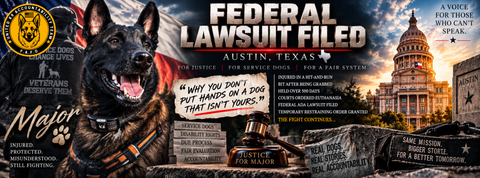
Major’s Federal Lawsuit Is On. The Bite Still Teaches the Same Rule. post
By: Craig R. Hanna Editor
Unmuzzled K9 Accountability Series
United K9 Accountability Team
Handler Brief: Major — Why You Don’t Put Hands on a Dog That Isn’t Yours
In our line of work, we say it until it sounds rude: if it is not your dog, do not put your hands on it.
That rule is not about being cold. It is about how dogs actually communicate. They do not file a statement. They do not say “I’m hurt, back up, I will bite if you grab me.” They use body language first. When that fails — or when a person ignores it and reaches in — they use teeth. That is not “evil.” That is the only language they have left.
The Austin case of Major, a Belgian Malinois held more than 500 days at Austin Animal Center, is a hard example of what happens when that rule is broken, then the system treats the bite as the whole story.
What happened
On March 31, 2025, Shane Lilly was walking Major in Austin’s Montopolis area when a hit-and-run pickup struck the dog and fled. Major’s rear left leg was bleeding. Lilly left the dog on a porch and ran for a phone. While he was gone, bystanders tried to load the injured dog into a car to get him to a vet. Julissa Alvarez tried to pick Major up from behind. He bit both of her arms. Injuries were serious: punctures, missing skin, estimates of 10–12 stitches.
more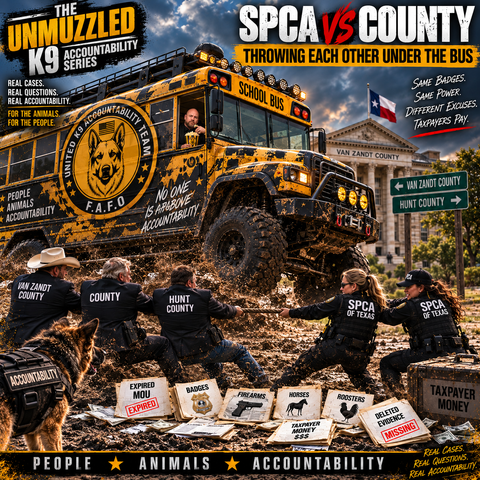
OPINION | Has the SPCA of Texas Poisoned the Well for Animal Welfare in East and North Texas?
Van Zandt County, Texas — September 9, 2026
Today, the Van Zandt County Commissioners Court was asked to consider an increase in budget funding for the Animal Protection League.
County Judge Andy Reese spoke about the positive work the Animal Protection League has performed and the benefit its services provide to the community.
But something else caught the attention of citizens listening to the meeting.
The commissioners were noticeably quiet.
Silence does not prove opposition, concern, or wrongdoing. There could be many reasons commissioners chose not to speak extensively about the issue.
But considering what Van Zandt County and neighboring Hunt County are currently facing over their relationships with another animal-welfare nonprofit, the silence raises an important question.
Has the SPCA of Texas controversy poisoned the well for legitimate animal-welfare organizations across East and North Texas?
THE ANIMAL PROTECTION LEAGUE IS NOT THE SPCA OF TEXAS
That distinction needs to be made immediately.
The Animal Protection League and the SPCA of Texas are separate organizations.
more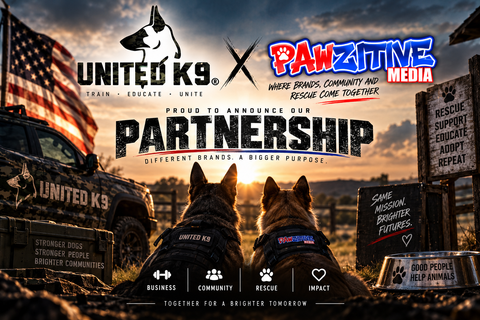
United K9 Academy HQ Partners With Pawzitive Media to Help Turn Business Into Impact
By: Craig Hanna
United K9 Academy HQ Partners With Pawzitive Media to Help Turn Business Into Impact
A new partnership brings together business, community, animal welfare, and a shared belief that success should be used to make a difference.
United K9 Academy HQ is proud to announce its partnership with Pawzitive Media, a growing media and marketing company built around a mission that reaches far beyond advertising.
For United K9, this partnership isn't simply about social media, marketing, or growing a brand.
It's about supporting a mission.
Pawzitive Media operates under a simple idea: “Where Brands, Community, and Rescue Come Together.” The company uses its platform to support small businesses while also bringing awareness to shelters and rescue organizations. A portion of its services also helps support animal shelters and rescue initiatives.
That combination of business and purpose is exactly why United K9 Academy HQ wanted to get involved.
BUSINESS CAN DO MORE
Businesses spend thousands of dollars every year on advertising, marketing, websites, social media, and events.
Pawzitive Media is working to turn some of that normal business activity into something bigger.
more
WHEN RESCUE BECOMES ABOUT THE RESCUER
By United K9 Accountability/ Craig Hanna & Featuring commentary originally published by Darcy Butkus, Inspector Bark
Inspector Bark Raises Questions About Accountability, Transparency, and the Culture Surrounding Animal Rescue
Featuring commentary originally published by Darcy Butkus, Inspector Bark
Animal rescue is supposed to be about one thing: the animals.
But what happens when the organization, activist, investigator, or individual doing the rescuing becomes the center of the story?
That is the question raised in a recent commentary published by Darcy Butkus of Inspector Bark, a licensed private investigator whose work examines conduct within the animal-care and rescue community.
Her message addresses a subject that deserves serious discussion: the difference between legitimate animal advocacy and what she describes as “rogue rescue.”
When the Mission Becomes the Image
Inspector Bark argues that rescue can sometimes shift away from helping animals and toward attention, control, praise, money, and maintaining a particular public image.
Among the warning signs she identifies are organizations or individuals who seemingly must always be portrayed as the hero, while anyone questioning their actions is immediately treated as an enemy.
more
The Court Has Spoken — So Why Are Animal Activists Talking About Following Her for Five Years?
By: Craig R Hanna
UNMUZZLED The K9 Accountability Series
A Dallas animal-cruelty case raises a larger question about where animal advocacy ends and private vigilantism begins.
DALLAS, TEXAS — A highly publicized animal-cruelty case in North Texas has reached a resolution through a plea agreement. But comments made by animal activists following that resolution are now raising an entirely different concern.
What happens when activists disagree with the outcome of a criminal case and decide the punishment imposed through the justice system isn't enough?
The case involves Turkessa Blackmon, who was arrested in Dallas in October 2025 after video circulated online that authorities alleged showed a stray dog being beaten. CBS Texas reported that Blackmon, then 49, was charged with cruelty to non-livestock animals, a third-degree felony.
The incident generated significant attention from animal activists, some of whom closely followed the criminal case and wanted a severe punishment.
But the case ultimately did not end with the trial some activists apparently wanted.
It ended with a plea deal.
more
When Justice Comes With a $5,000 Price Tag: Is the Government Creating the Wrong Incentive in Animal-Cruelty Investigations?
By United K9 Accountability Team I Opinion
On August 11, 2026, federal authorities announced a new FBI tip line and a $5,000 reward for information leading to the successful prosecution of individuals who violate the federal Preventing Animal Cruelty and Torture Act, commonly known as the PACT Act.
Protecting animals from genuine cruelty is a legitimate and important function of law enforcement. People who deliberately torture or seriously abuse animals should be investigated and, when the evidence proves the offense beyond a reasonable doubt, prosecuted.
But attaching thousands of dollars to information supplied against another person raises a question that should not be dismissed simply because the underlying cause is popular:
What happens when reporting suspected animal cruelty comes with a financial incentive?
A Tip Is Not Evidence of Guilt
There is an important distinction in the federal announcement: the government is not promising $5,000 merely for making an accusation. The announced reward is tied to information resulting in a successful prosecution.
That safeguard matters.
But it does not answer every concern.
The person providing the original information knows that money may ultimately be available. That creates a financial interest that investigators, prosecutors and courts should take seriously when evaluating the credibility and motivation of a tipster.
more
Not Guilty Yet, But Your Animals Are Gone
United K9 Accountability Team
Texas can protect animals from cruelty. But who protects the constitutional rights of the people accused?
By United K9 Accountability Team
Imagine law enforcement arriving at your property with a warrant and taking your dogs, horses, livestock, or other animals based on allegations of cruelty or neglect.
You have not been convicted of a crime. A criminal jury has not heard the evidence. Your attorney has not cross-examined the government's witnesses at a criminal trial. The State has not proven beyond a reasonable doubt that you committed animal cruelty.
Yet within days, you could be fighting a separate civil proceeding that may determine whether those animals ever come home.
That is one of the difficult realities of Texas animal-seizure law—and it raises a question that extends far beyond animal welfare:
Where should Texas draw the line between protecting animals and protecting the constitutional and property rights of its citizens?
Texas does not have to choose one over the other. It should be capable of doing both.
A Decision That Can Come Long Before a Criminal Trial
Texas Health and Safety Code Chapter 821 establishes a process for the seizure and disposition of animals alleged to have been cruelly treated. Under § 821.022, an officer may apply for a seizure warrant, and upon a showing of probable cause, the court issues the warrant and sets a hearing within 10 calendar days of its issuance to determine whether the animal was cruelly treated.
more
Unlawful Raid Collapses: How a Botched SPCA Seizure in Van Zandt County Sparked Federal Questions and a Judicial Dismissal
United K9 Magazine and United K9 Accountability Team
GRAND SALINE, TX — Dust was still settling on the dirt driveway when the line of law enforcement cruisers and unmarked box trucks pulled up to Justin Hart’s farm. For generations, the morning sound around here was the steady crowing of prize game fowl. But on this morning, the birds were cut short by the slam of car doors and the heavy presence of deputies and SPCA of Texas investigators.
What was framed to the public as a high-stakes cockfighting raid was, under the surface, something much more complicated and personal.
Just seven days earlier, Justin’s brother, Shelby Herron, had fired off a formal demand letter to Van Zandt County and the SPCA of Texas. The letter called out what the family maintained was the outright theft of dogs over in neighboring Kaufman County. A week later, SPCA officers were on Justin’s property, hauling off 181 of his prize birds.
The raid quickly turned into a free-for-all. Officers grabbed items that weren't listed anywhere on the warrant. The birds healthy, valuable breeding stock were crammed into tiny cat carriers and stacked inside the back of a hot box truck like cargo.
Leading the charge on-scene were SPCA investigator Randi Dykes and Chief Investigator Courtney Burns. But as cameras snapped photos of the operation, major legal red flags started popping up. Photos captured Chief Burns directly handling and sorting through items on the evidence table. The problem? Burns’ legal authority belongs strictly in Hunt County. Under Texas law, humane society officers aren't free-roaming law enforcement; their authority is tied directly to local Memorandums of Understanding (MOUs). Burns had zero legal jurisdiction to touch evidence in Van Zandt County.
more
GUILTY UNTIL PROVEN INNOCENT? THE FIGHT FOR DOGTOWN RANCH
United K9 Accountability Team
In the quiet stretches of Milam County, Texas, the dust rarely settles when the subject turns to Dogtown Ranch Rescue & Sanctuary. For animal advocate Todd Smith, founder of God Bless the Dog, the issue is personal, urgent, and straightforward. Smith has spent months calling out local authorities, publicly challenging the Milam County Sheriff’s Office for what he views as a critical failure to hold the sanctuary accountable. His message to the public has been blunt and unapologetic, driven by a stance that, in the court of public opinion, some entities ought to be treated as guilty until proven innocent when animal lives are on the line.
That philosophy, however, runs headfirst into a brick wall when it hits the formal legal system.
The standoff reached a critical juncture when state protocol and institutional oversight intersected with daily law enforcement mandates. Following guidelines outlined in the Texas Animal Cruelty Manual, the Milam County Sheriff’s Office instituted routine, on-site walkthroughs at Dogtown. To further ensure statutory compliance, outside authorities were brought in to perform a comprehensive evaluation. Experienced inspectors including veterinary staff and Chief Investigator Courtney Burns from the SPCA of Texas, alongside representatives from Humane World conducted a walk-through of the property. They walked the grounds, evaluated the animals, and filed their report, concluding there were no actionable violations under Texas animal cruelty statutes.
more
New White Paper Reveals Widespread SPCA Due Process Violations
United K9 Magazine
June 17, 2025
Litigation for Animal Welfare (LAW) Releases White Paper Exposing Widespread SPCA Overreach and Due Process Violations
New report highlights unconstitutional seizures, breed-targeting, and the urgent need for nationwide reform
WASHINGTON, D.C. — Litigation for Animal Welfare Inc. (LAW) today released “UNCHECKED AUTHORITY: SPCA Overreach – Targeting Breeds and Eroding Due Process,” a comprehensive white paper detailing a growing national crisis involving unlawful animal seizures, excessive financial penalties, and discriminatory enforcement practices by certain Society for the Prevention of Cruelty to Animals (SPCA) chapters.
The report identifies a troubling pattern: pets confiscated without warrants, owners denied hearings, animals rehomed or euthanized before legal review, and families pressured into silence through gag orders or excessive care fees. LAW is now evaluating a potential federal class action lawsuit to address systemic constitutional violations.
SPCA Overreach: A National Pattern Emerges
While many SPCA chapters operate ethically and save thousands of animals, LAW’s white paper reveals that others routinely act with quasi-law enforcement power but little accountability. Key findings include:
more
WHEN ANIMAL WELFARE GOES TOO FAR?
WHEN ANIMAL WELFARE GOES TOO FAR?
An Investigative Look Into Allegations of SPCA Overreach in Rural Texas**
By: Craig R. Hanna- United K9 Magazine
Investigator BL Cozad
Across Texas, animal welfare organizations often stand at the front lines of rescuing neglected and abused animals. But in several rural counties, concerns are growing that some enforcement actions—intended to protect animals—may instead be causing unintended harm to the very communities they serve.
Recently, a private investigator submitted a detailed report to United K9 Magazine outlining a series of serious allegations regarding SPCA-related operations in Hunt County and Van Zandt County, Texas. These allegations, which remain unproven in a court of law, center on claims of improper seizures, due process violations, and questionable partnerships between nonprofit animal organizations and local officials.
United K9 Magazine has reviewed the information and spoken with several sources as part of an ongoing investigation.
A Pattern of Complaints From Rural Pet Owners
According to the private investigator, at least five residents across Hunt and Van Zandt counties claim they were subjected to unlawful animal seizures based on what they describe as exaggerated or fabricated allegations of cruelty or neglect.
more
Press Release: What Hunt County TX and the SPCA of Texas Don’t Want You to Know: The United K9 Story
United K9 Magazine
Truth, Transparency, and Trust: Standing Strong for Our K9 Community
In the world of animal care and training, integrity isn’t just a word it’s the foundation of every relationship we build, every dog we train, and every client who trusts us with their four-legged family members. Recently, United K9 Academy found itself caught in the crossfire of misinformation, bureaucratic failure, and misuse of authority. Today, we’re sharing our story to ensure the truth is known and the community we serve continues to stand united.
On April 1, 2024, a joint operation by the SPCA Of Texas and Hunt County Sheriff’s Office raided a separate facility, K9 Academy (who’s story will be coming out). Despite having no involvement with that business, United K9 Academy’s name was wrongfully linked in the SPCA’s initial press release. Within hours, that misinformation spread online resulting in threats, reputational damage, and personal risk to our founder and staff.
Just days later, on April 3, the Hunt County Sheriff’s Office arrested our founder based on a complaint riddled with inconsistencies and procedural violations. No animals were seized during the arrest a detail that contradicts the very mission the SPCA claims to uphold. Under Texas law, when a caretaker is detained, animals must receive immediate care and evaluation. None of that happened.
more