
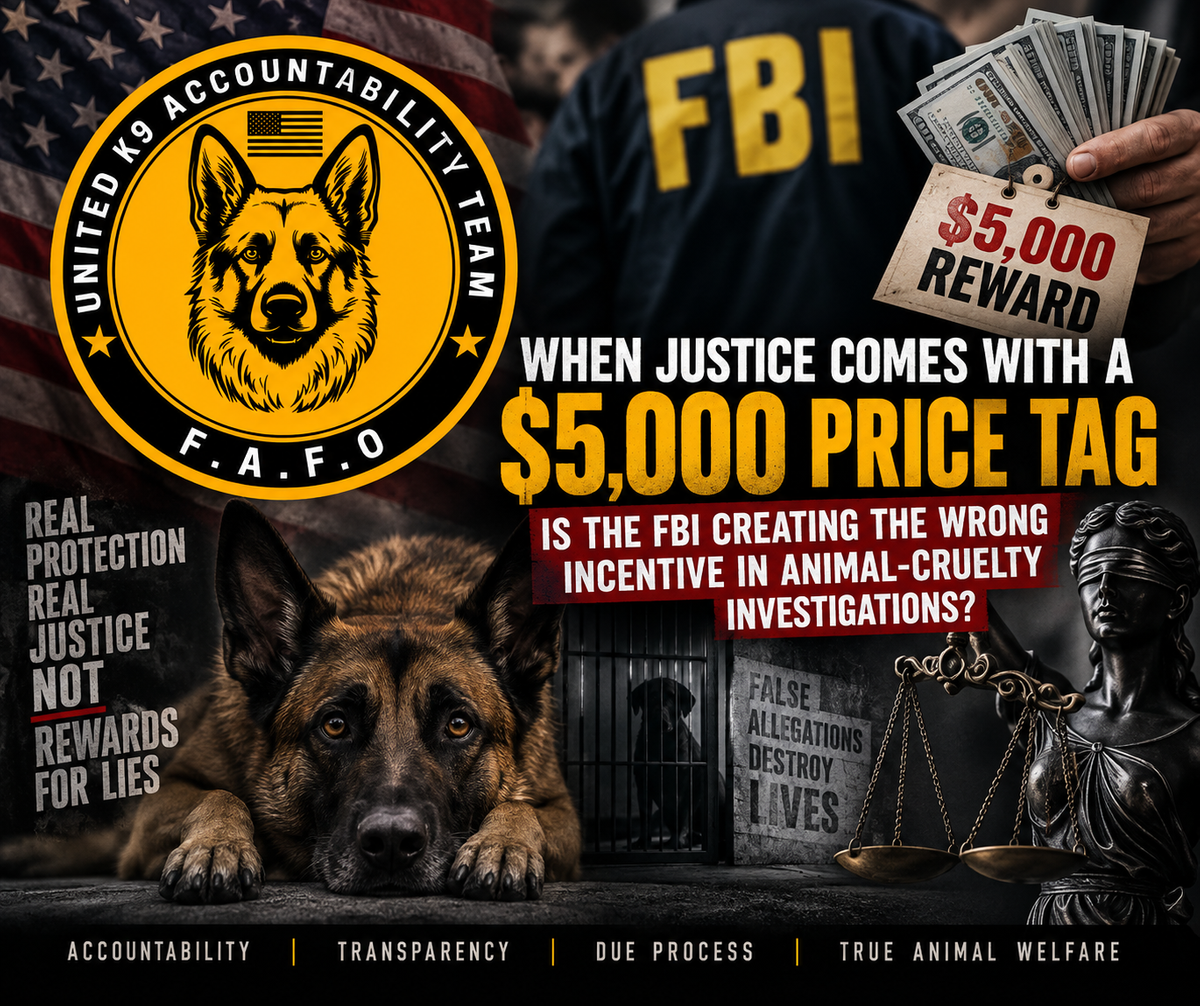
On August 11, 2026, federal authorities announced a new FBI tip line and a $5,000 reward for information leading to the successful prosecution of individuals who violate the federal Preventing Animal Cruelty and Torture Act, commonly known as the PACT Act.
Protecting animals from genuine cruelty is a legitimate and important function of law enforcement. People who deliberately torture or seriously abuse animals should be investigated and, when the evidence proves the offense beyond a reasonable doubt, prosecuted.
But attaching thousands of dollars to information supplied against another person raises a question that should not be dismissed simply because the underlying cause is popular:
What happens when reporting suspected animal cruelty comes with a financial incentive?
A Tip Is Not Evidence of Guilt
There is an important distinction in the federal announcement: the government is not promising $5,000 merely for making an accusation. The announced reward is tied to information resulting in a successful prosecution.
That safeguard matters.
But it does not answer every concern.
The person providing the original information knows that money may ultimately be available. That creates a financial interest that investigators, prosecutors and courts should take seriously when evaluating the credibility and motivation of a tipster.
A person who previously might have said, “I don't know exactly what happened,” could now have thousands of reasons to characterize ambiguous circumstances in the most incriminating way possible.
That doesn't mean every tipster will lie.
It means investigators should recognize that money can create bias.
The Damage Can Begin Long Before Trial
In an animal-cruelty investigation, the consequences of an accusation can begin well before a jury ever hears the evidence.
A person's animals may be seized. Search warrants may be executed. Businesses can lose customers. Employers, neighbors and social-media audiences may learn about allegations. Photographs of seized animals can circulate online without the accused person's explanation or evidence receiving comparable attention.
For someone who operates a kennel, ranch, rescue, veterinary-related business, breeding operation or animal-training company, merely being publicly associated with the words “animal cruelty investigation” can cause devastating economic and reputational consequences.
Then imagine that the criminal case is dismissed, charges are rejected, or the person is acquitted.
A courtroom can dismiss a case.
It cannot necessarily restore lost customers, contracts, animals, employment opportunities or reputation.
Who Investigates the Informant?
The government's announcement says successful tips should contain specific evidence such as photographs, videos, dates, times, locations and descriptions of the alleged conduct.
Good.
But the public deserves additional answers.
When a tipster stands to receive $5,000, are investigators required to document that financial incentive in their reports?
Must prosecutors disclose the potential reward to the defense?
Will investigators independently corroborate allegations before seeking warrants or taking animals?
Will courts evaluating probable cause be informed that the source may have a financial interest in the outcome?
What happens when a tipster exaggerates evidence in hopes of qualifying for the reward?
And what safeguards exist to prevent personal enemies, disgruntled employees, former spouses, business competitors or activist groups from attempting to turn the reward system into a weapon?
These aren't arguments against prosecuting animal cruelty.
They are arguments for credible investigations.
Follow the Evidence, Not the Reward
The federal announcement specifically requests evidence photos, videos, dates, times and locations.
That should become the standard.
Investigators should not build cases around emotionally powerful accusations and then search for evidence supporting them. They should independently examine veterinary records, body-camera footage, photographs, witness credibility, timelines, medications, feeding records, environmental conditions and other objective evidence before reaching conclusions.
And when the government knows that a witness potentially stands to receive money following a successful prosecution, that potential interest should be treated as relevant information not an inconvenient footnote.
The same principle applies everywhere else in the justice system: when a witness has something significant to gain from a particular outcome, credibility deserves additional scrutiny.
Animal Welfare and Due Process Are Not Enemies
This debate should not be reduced to two choices: either support animals or support constitutional rights.
We can do both.
Real animal abuse deserves serious investigation and prosecution.
But innocent people also deserve protection from false or financially motivated allegations.
If a $5,000 reward helps investigators obtain video of genuine animal torture and successfully prosecute the offender, the program may accomplish exactly what federal authorities intend.
But if financial incentives encourage people to exaggerate, speculate or manufacture allegations, the consequences could be devastating.
That is why the government's responsibility cannot end with creating a tip line and offering money.
The greater the incentive to accuse, the greater the obligation to independently verify.
The Question the FBI and Federal Prosecutors Should Answer
The question isn't simply, “How many animal-cruelty prosecutions can this program generate?”
The better question is:
“What safeguards ensure that the promise of $5,000 does not help turn an accusation into a financially motivated accusation and what protects an innocent person before irreversible damage is done?”
Animal welfare deserves legitimate investigations.
Victims of actual cruelty deserve justice.
But justice requires something more than good intentions.
It requires evidence, transparency, impartial investigators, meaningful due process and recognition that an allegation is not a conviction.
When the government puts a price tag on information leading toward prosecution, the public has every right to ask who is watching the incentives and who protects the person standing on the other side of the accusation.