
Van Zandt County, Texas — September 9, 2026
Today, the Van Zandt County Commissioners Court was asked to consider an increase in budget funding for the Animal Protection League.
County Judge Andy Reese spoke about the positive work the Animal Protection League has performed and the benefit its services provide to the community.
But something else caught the attention of citizens listening to the meeting.
The commissioners were noticeably quiet.
Silence does not prove opposition, concern, or wrongdoing. There could be many reasons commissioners chose not to speak extensively about the issue.
But considering what Van Zandt County and neighboring Hunt County are currently facing over their relationships with another animal-welfare nonprofit, the silence raises an important question.
Has the SPCA of Texas controversy poisoned the well for legitimate animal-welfare organizations across East and North Texas?
THE ANIMAL PROTECTION LEAGUE IS NOT THE SPCA OF TEXAS
That distinction needs to be made immediately.
The Animal Protection League and the SPCA of Texas are separate organizations.
The Animal Protection League should be judged on its own work, finances, contracts and conduct. It should not automatically inherit the controversy surrounding another nonprofit merely because both organizations work in animal welfare.
But county officials also cannot reasonably expect taxpayers to forget what has happened when another private animal-welfare organization was allowed to become deeply intertwined with local government and law enforcement.
That history is now part of the conversation.
THE SPCA CONTROVERSY HAS MOVED INTO FEDERAL COURT
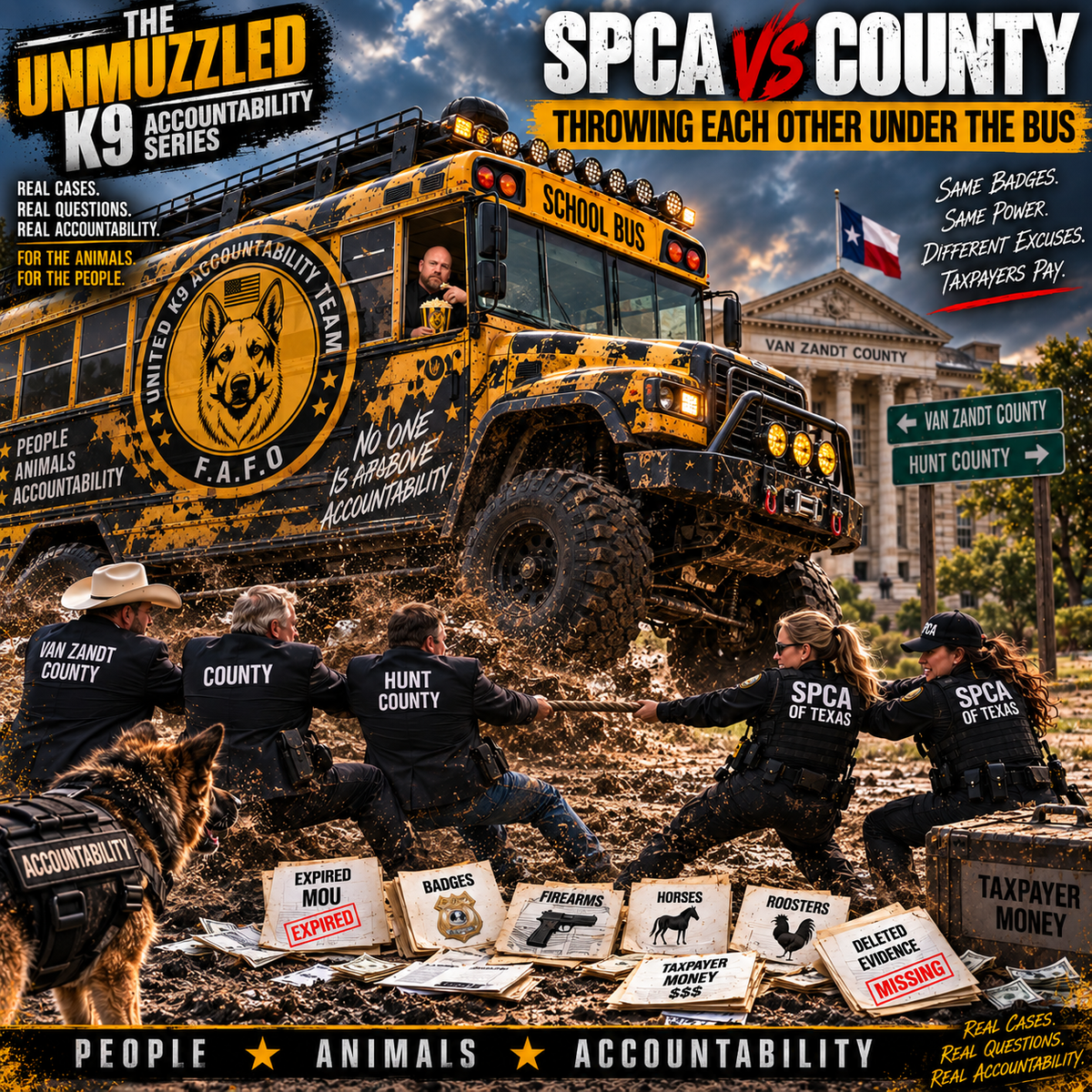
Van Zandt County and Hunt County are now defendants in federal civil litigation in the Northern District of Texas involving allegations connected to the SPCA of Texas and the governmental authority exercised by SPCA personnel.
The counties have sought dismissal of claims against them.
One of the central themes of their defense, according to the positions advanced in the litigation, is essentially that SPCA personnel were privately employed and that the counties should not be held responsible for their alleged conduct.
That creates an extraordinary accountability question.
If the counties did not control these private employees, who did?
The plaintiffs' position raises an even more uncomfortable question: Why were privately employed nonprofit personnel allegedly allowed to exercise governmental authority, carry badges associated with counties, and, according to the allegations, have access to county-issued firearms if county officials now contend they lacked meaningful oversight over their day-to-day conduct?
The lawsuit further disputes whether the underlying MOUs and commissioning arrangements remained valid throughout the relevant periods.
These are contested legal and factual issues. A motion to dismiss is not a final judgment, and the court not either side is ultimately responsible for determining which claims survive and what the evidence establishes.
But the competing positions alone expose a problem taxpayers should be paying attention to.
WHO WAS ACTUALLY IN CHARGE?
The counties' position becomes even more complicated when compared with the SPCA of Texas's own litigation position.
While the counties seek distance from the conduct of privately employed SPCA personnel, the SPCA has argued that its investigators were operating in conjunction with county law enforcement and under governmental authority.
In other words, the defendants appear to be drawing very different pictures of the same relationship.
The counties effectively argue:
They weren't our employees, and we aren't responsible for everything they did.
The SPCA's position, meanwhile, emphasizes its investigators' governmental role and relationship with county sheriffs.
That leaves taxpayers with the obvious question:
Which was it?
Were these essentially private nonprofit employees acting independently?
Or were they functioning as commissioned law-enforcement personnel subject to county authority and supervision?
If the answer somehow falls between the two, then taxpayers deserve to know exactly where private nonprofit activity ended and governmental police authority began.
BADGES, FIREARMS AND POLICE POWER REQUIRE OVERSIGHT
This is where the issue becomes bigger than a disagreement over paperwork.
According to allegations in the litigation and records being disputed by the parties, SPCA personnel were provided or permitted to use governmental badges and law-enforcement authority, and questions have been raised concerning county-issued firearms and whether underlying agreements had expired.
If those allegations are established, taxpayers should demand an explanation.
A badge isn't a marketing credential.
A firearm isn't a fundraising tool.
And police power isn't something government should hand to a private organization and then later argue it wasn't responsible for supervising how that authority was exercised.
Government cannot reasonably have it both ways.
If a county gives someone governmental police authority, the public has every reason to expect that government to know who that person is, what authority they possess, where they can exercise it, what rules govern them and who is supervising them.
A PRIVATE NONPROFIT WITH A FINANCIAL INCENTIVE
There is another uncomfortable element that deserves scrutiny.
The SPCA of Texas is a private nonprofit organization that relies in significant part on donations and public support.
Its investigations and animal seizures have also generated publicity, press releases and fundraising appeals.
That does not automatically mean an investigation was improper, and fundraising by a nonprofit is not itself evidence of misconduct.
But combining law-enforcement authority with an organization that also benefits from publicity and donations creates an obvious need for strong safeguards and independent oversight.
Instead, the litigation now raises the opposite question:
Was sufficient governmental oversight there at all?
If the counties' own defense is that they should not be responsible for privately employed SPCA personnel, that argument may protect taxpayer money in one sense—but it simultaneously raises serious public-policy concerns about why private personnel were entrusted with governmental authority in the first place.
THE CASES THAT CREATED THE QUESTIONS
These concerns did not suddenly appear because someone filed a federal lawsuit.
Multiple incidents and cases have generated questions regarding SPCA investigative practices and governmental authority.
Those include allegations involving horses being taken from a citizen after law-enforcement authority was invoked; the seizure of roosters associated with the Justin Hart matter; disputes involving allegedly deleted or unavailable evidence in the Hull matter; and allegations that SPCA personnel crossed county boundaries while displaying badges or exercising authority connected to commissions from another jurisdiction.
There are also continuing disputes about evidence handling, communications, jurisdiction, commissioning documents and information from investigations allegedly being used for publicity or fundraising.
These allegations remain subject to proof, rebuttal and judicial review.
But collectively, they demonstrate why oversight matters.
NOW TAXPAYERS MAY PAY FOR EVERYONE'S STUBBORNNESS
Here is perhaps the most frustrating part.
Government officials and private organizations can spend years pointing fingers at one another.
The county can say:
They're private employees.
The nonprofit can say:
We were working under county law-enforcement authority.
Attorneys can argue over immunity, municipal liability, state action, supervision, jurisdiction and who controlled whom.
But somebody still pays those attorneys.
The taxpayers.
Every additional motion, hearing, deposition, discovery dispute and defense expense can translate into additional costs somewhere in the governmental system.
If mistakes were made, refusing to acknowledge and correct them does not necessarily protect taxpayers.
Sometimes stubbornness simply makes the eventual bill larger.
AND THAT BRINGS US BACK TO THE ANIMAL PROTECTION LEAGUE
Today's funding discussion should therefore serve as an opportunity—not an accusation.
The Animal Protection League should not be punished for allegations involving the SPCA of Texas.
But Van Zandt County should have learned something from this experience.
Any relationship between government and a private animal-welfare organization should clearly establish:
Who controls the organization?
What taxpayer money is paying for?
What services are being provided?
Whether the organization possesses any governmental authority?
Who supervises its personnel?
What insurance and liability protections exist?
What happens when something goes wrong?
And where does the county's responsibility begin and end?
Those questions should be answered before taxpayer money changes hands—not years later in federal court.
HAS THE SPCA OF TEXAS DAMAGED ANIMAL WELFARE ITSELF?
This may ultimately be the saddest consequence of the controversy.
There are legitimate organizations doing legitimate animal-welfare work throughout Texas.
There are volunteers helping animals because they genuinely care.
There are nonprofits providing low-cost vaccinations, spay-and-neuter programs, food assistance and other services that communities desperately need.
But when the line between private nonprofit activity and government police authority becomes blurred, public trust suffers.
And once that trust disappears, every organization operating in the same field feels the consequences.
The Animal Protection League deserves to be judged by the Animal Protection League's actions.
But taxpayers also deserve something that should have existed from the beginning of every government-nonprofit partnership:
Transparency. Oversight. Clear authority. And accountability.
If the allegations now being litigated ultimately show that counties gave substantial governmental authority to privately employed SPCA personnel while exercising inadequate oversight, then county officials will have far more to explain than an expired piece of paper.
They will have to explain how that system was allowed to operate for years.
And if the SPCA simultaneously maintains that its personnel were acting for and under county law enforcement while the counties attempt to distance themselves from those same personnel, a federal court may ultimately have to determine where responsibility actually lies.
Until then, taxpayers should keep asking questions.
Because whether the defendants eventually win or lose, taxpayers may still be paying the lawyers to untangle a relationship that government officials should have clearly defined years ago.
The Animal Protection League did not create that problem.
But today’s Commissioners Court discussion demonstrates how far the consequences may have spread.
Perhaps the greatest damage caused by the SPCA controversy isn't contained in any single lawsuit, seizure or investigation.
Perhaps it is that citizens now look at even legitimate animal-welfare partnerships with their county government and wonder:
“Who is watching them?”
That loss of trust may prove much harder to repair than any contract.
EDITOR'S NOTE: This is an opinion article. Statements concerning pending federal litigation, SPCA investigations, county oversight, commissions, MOUs, firearms, seizures, evidence handling and individual cases include allegations and disputed legal positions. Allegations are not findings of fact. The defendants may dispute those characterizations, and the court has the authority to determine the legal and factual issues presented in the litigation.