
Unmuzzled K9 Accountability Series
United K9 Accountability Team
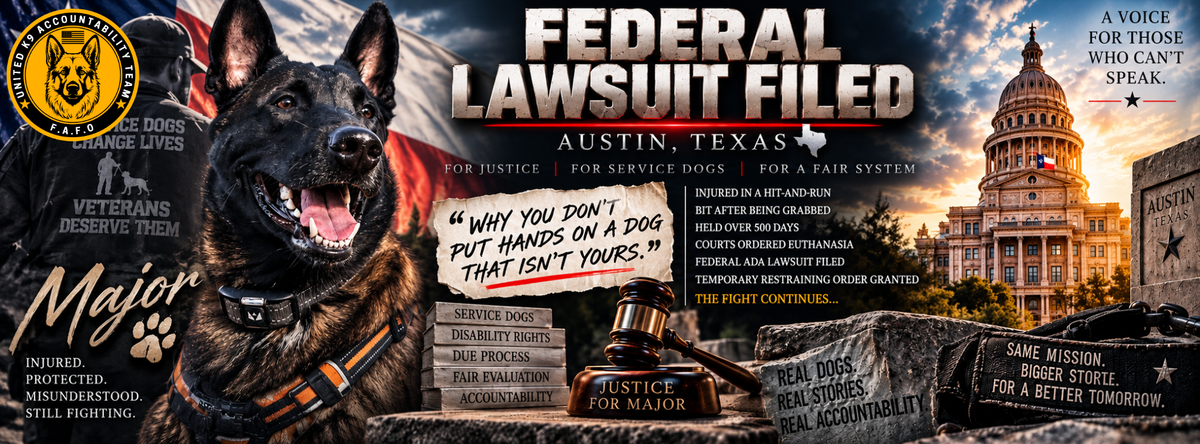
Handler Brief: Major — Why You Don’t Put Hands on a Dog That Isn’t Yours
In our line of work, we say it until it sounds rude: if it is not your dog, do not put your hands on it.
That rule is not about being cold. It is about how dogs actually communicate. They do not file a statement. They do not say “I’m hurt, back up, I will bite if you grab me.” They use body language first. When that fails — or when a person ignores it and reaches in — they use teeth. That is not “evil.” That is the only language they have left.
The Austin case of Major, a Belgian Malinois held more than 500 days at Austin Animal Center, is a hard example of what happens when that rule is broken, then the system treats the bite as the whole story.
What happened
On March 31, 2025, Shane Lilly was walking Major in Austin’s Montopolis area when a hit-and-run pickup struck the dog and fled. Major’s rear left leg was bleeding. Lilly left the dog on a porch and ran for a phone. While he was gone, bystanders tried to load the injured dog into a car to get him to a vet. Julissa Alvarez tried to pick Major up from behind. He bit both of her arms. Injuries were serious: punctures, missing skin, estimates of 10–12 stitches.
The seizure warrant itself described the bite as “provoked.” Alvarez later said she did not want to testify against the dog and did not believe the bite was Major’s fault. That did not stop the case. Under Texas Health & Safety Code § 822.003, once a court finds a dog caused serious bodily injury, the statute points toward humane destruction. Municipal court ordered euthanasia. County court at law affirmed. The Third Court of Appeals affirmed. The Texas Supreme Court declined further review.
Major has sat in isolation in Kennel 600 at Austin Animal Center since that day over 500 days. Staff have said that kind of stay is not healthy and that he is deteriorating. Typical time in that unit is about a month. He has not been handled or walked like a normal shelter dog.
This week Lilly’s lawyers filed a federal ADA suit in the Western District of Texas, arguing Major is a service animal trained to help Lilly with traumatic brain injury and seizure-related tasks, and that the city moved to kill him without properly evaluating that role. Senior U.S. District Judge David Alan Ezra granted a temporary restraining order blocking euthanasia while the federal case proceeds. The city says it will follow the court and keep caring for the dog.
What handlers already know
An injured working dog on a porch is not a stuffed animal. Pain, startle, and a stranger coming in from behind is a stacked setup. From behind is one of the worst approaches you can make on a dog you do not know. You take away their eyes. You take away their exit. You put hands on the body. If that dog has any defense drive, protection history, or simply a broken leg and no relationship with you, teeth are the remaining tool.
Belgian Malinois are not Labrador-soft by default. Many are bred and started for work. Lilly purchased Major as a puppy from a protection-oriented program and later used the dog for balance, doors, and owner-directed work. Whether that meets the federal definition of a service dog is now a courtroom question. What is not a courtroom question for us is this: a hurt Malinois, left alone, approached from the rear by a stranger, is a bite risk. That is handler literacy, not Monday-morning lawyering.
Dogs give warnings if people look. Freeze. Whale eye. Lip lift. Weight shift. Growl. Snap. If humans miss those or override them “to help,” the next communication is a bite. Then the record often reads only “the dog attacked.” The context hit by a car, owner gone, hands on from behind gets treated as a footnote.
We are not blaming a civilian who thought she was saving a life. Good intent does not change canine mechanics. If you do not own the dog, you do not own the risk. Call animal control. Contain from a distance. Do not scoop.
What this case also shows trainers
Prolonged isolation after a bite does not make a dog safer. It often makes the next assessment worse. A year-plus in a no-touch kennel is not a behavior plan. It is storage. If courts only ask “did this dog cause serious bodily injury,” they never reach the questions handlers ask every day: Was the dog injured? Was the approach wrong? Can the dog be evaluated after decompression? Is euthanasia the only tool, or the easiest one?
Service-dog claims will be fought on facts: task training versus online certificates and protection work. That fight belongs in court. Our lane is simpler and older than the ADA.
Do not touch a dog that does not belong to you.
Dogs talk with body first and teeth last.
An injured working dog is not a rescue prop.
United K9 Accountability Team will be watching this case as more details the federal complaint, the written TRO, and any behavior evaluation the court allows come in. We will update handlers when the record, not the rumor, moves.